
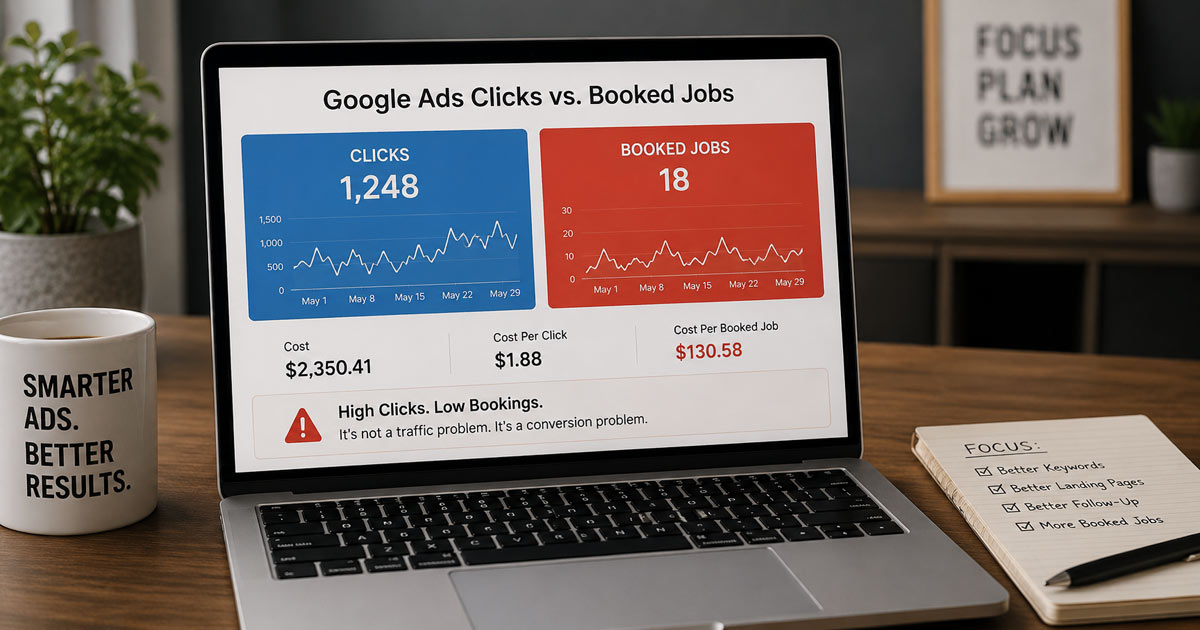
Getting clicks from Google Ads is not the same as getting customers. Many West Palm Beach businesses spend money every month driving people to their website, but those visits do not always turn into phone calls, form submissions, consultations, estimates, or booked jobs. When that happens, it is easy to assume the campaign needs more budget. In reality, more traffic often just means more wasted spend if the campaign is attracting the wrong people or sending them into a broken conversion path.
The real issue is usually somewhere between the click and the booked job. A campaign may be targeting low-intent keywords, showing ads to people outside the ideal service area, sending visitors to a weak landing page, or tracking the wrong actions as conversions. Even when a legitimate lead comes in, poor intake, slow follow-up, missed calls, or unclear lead attribution can make the campaign look like it is performing when revenue says otherwise.
For local businesses in West Palm Beach, Google Ads performance should not be judged by clicks alone. The better question is whether those clicks are producing qualified leads that your team can convert into real work. Before increasing the budget, businesses need to understand where the breakdown is happening: traffic quality, landing page conversion, tracking accuracy, or intake performance.
Table of Contents
- Why Clicks Are Not the Same as Booked Jobs
- How Low-Intent Keywords Waste Budget
- Where Landing Pages Break
- Why Tracking Gaps Hide Performance Issues
- What to Review Before Increasing Budget
- How Riley Summers Can Help
Why Clicks Are Not the Same as Booked Jobs
A Google Ads click is only the first step in the customer journey. It means someone saw your ad, found it relevant enough to click, and landed on your website or landing page. It does not mean they were ready to call, request a quote, schedule service, book an appointment, or choose your business over a competitor. This is why a campaign can look active inside Google Ads while still failing to produce meaningful revenue. For West Palm Beach businesses, the difference between a click and a booked job often comes down to intent. Some users are actively looking for a local provider they can hire now. Others are researching prices, comparing options, looking for free information, searching outside your service area, or clicking on an ad that does not fully match what they need. If your campaign pays for too many low-intent clicks, the budget gets used, but the business does not see enough qualified leads.
This is especially important for local service businesses where every click has a cost. Paying for traffic is only valuable when that traffic has a realistic chance of becoming a customer. A campaign that drives hundreds of visitors but produces few calls, poor form submissions, or unqualified inquiries is not a traffic problem. It is a quality and conversion problem.
When Google Ads are not generating leads, the first question should not be, “How do we get more clicks?” The better question is, “Are we paying for the right clicks, and what happens after those people land on the page?” Until that is clear, increasing the budget may only increase wasted spend.
How Low-Intent Keywords Waste Budget
Low-intent keywords are searches that may be loosely connected to your service but do not clearly show that the person is ready to buy, call, schedule, or request help. These clicks can make a Google Ads campaign look busy because they increase impressions, traffic, and overall activity. The problem is that activity does not always translate into qualified leads or booked jobs.
For example, someone searching for general advice, definitions, pricing information, DIY solutions, or broad educational content is usually in a different stage of the buying process than someone searching for a local company to hire today. If your campaign relies too heavily on broad keywords or loosely controlled match types, Google may show your ads to people whose searches are related to your service but not aligned with immediate customer intent.
In a competitive local market like West Palm Beach, that can become expensive quickly. Every irrelevant click uses part of the budget that could have gone toward a stronger prospect. Over time, low-intent searches can drain ad spend, reduce lead quality, and make it harder to understand which parts of the campaign are actually working.
A stronger Google Ads campaign should separate high-intent searches from low-value traffic. That means reviewing search terms regularly, adding negative keywords, tightening match types, excluding irrelevant queries, and shifting more budget toward searches that show real buying intent. The goal is not to pay for every possible visitor. The goal is to pay for the searches most likely to become real leads and revenue.
Where Landing Pages Break
Even when the traffic is qualified, the landing page can still break the conversion path. If the page does not quickly explain what you do, where you serve, why someone should trust you, and what they should do next, potential customers may leave without contacting you.
Common landing page problems include weak calls to action, slow load times, generic messaging, poor mobile layout, confusing forms, missing phone numbers, or a lack of trust signals such as reviews, testimonials, service proof, or local relevance.
A landing page for a West Palm Beach campaign should feel specific, direct, and conversion-focused. It should not read like a generic service page that could apply to any business in any market.
The page should answer the visitor’s immediate questions and make the next step obvious. If the user has to search for your phone number, wonder whether you serve their area, or figure out what happens after they submit a form, the page is creating friction.
Why Tracking Gaps Hide Performance Issues
Tracking gaps can make a Google Ads campaign look better than it really is. If you are only measuring clicks, impressions, or basic form submissions, you may not know whether the campaign is actually producing qualified leads or booked work.
This is where many businesses lose visibility. A form submission may not be a real opportunity. A phone call may be too short to matter. A lead may come from outside the service area. A booked job may come from a different campaign than the one receiving credit.
Without proper tracking, businesses often make budget decisions based on incomplete data. They may increase spend on campaigns that produce activity but not revenue, or pause campaigns that actually generate better-quality leads.
Effective tracking should connect ad spend to meaningful actions, including phone calls, form submissions, lead quality, booked jobs, and revenue when possible. The closer your reporting gets to real business outcomes, the easier it becomes to reduce wasted spend.
What to Review Before Increasing Budget
Increasing your Google Ads budget can help when the campaign is already producing qualified leads efficiently. But if the campaign has keyword, landing page, tracking, or intake problems, more budget usually creates more waste.
Before spending more, review the full path from search to sale. Look at which keywords are driving traffic, which search terms are wasting spend, whether conversion tracking is accurate, whether leads are qualified, and whether your team is responding quickly enough to calls and forms.
You should also review what happens after the lead comes in. If calls are missed, forms are answered too slowly, or intake does not qualify leads properly, the campaign may appear to underperform even when the advertising is doing its job.
The goal is to identify whether the breakdown is happening before the click, after the click, or after the lead is submitted. Each issue requires a different fix.
Frequently Asked Questions About Google Ads Clicks That Do Not Turn Into Jobs in West Palm Beach
Why am I getting Google Ads clicks but no leads in West Palm Beach?
Getting clicks without leads usually means there is a disconnect between traffic quality, landing page performance, or conversion tracking. For West Palm Beach businesses, common causes include targeting broad keywords, weak calls-to-action, poor mobile experiences, or attracting users outside the service area.
Can low-intent keywords waste Google Ads budget?
Yes. Low-intent keywords often attract users researching, comparing options, or looking for information rather than hiring a business. In competitive West Palm Beach industries, paying for irrelevant clicks can quickly increase costs without improving booked jobs or revenue.
How do I know if my Google Ads campaign is attracting the wrong audience?
You should review search term reports, geographic targeting, conversion data, and lead quality. If most inquiries are unqualified, outside your service area, or unrelated to your services, your campaign may be paying for traffic that is unlikely to convert into customers.
Why are clicks not the same as booked jobs?
A click only shows interest in an ad. Booked jobs require multiple steps afterward, including a strong landing page, clear messaging, easy contact methods, fast follow-up, and an effective sales or intake process. Problems anywhere in that path can reduce conversions.
Should West Palm Beach businesses increase their Google Ads budget if leads are low?”
Not immediately. Increasing spend before identifying why leads are underperforming may only increase wasted budget. Businesses should first evaluate keyword targeting, landing page conversion rates, call tracking, form tracking, and lead quality.
How important is local targeting for Google Ads in West Palm Beach?
Local targeting is critical. Campaigns should focus on the specific cities, ZIP codes, and service areas where businesses operate. Poor location settings can result in paying for clicks from users who are outside the target market and unlikely to become customers.
Can a poor website or landing page hurt Google Ads performance?
Yes. Even highly qualified traffic may leave without converting if the landing page is slow, confusing, lacks trust signals, or does not clearly explain the service and next steps. Strong campaigns require both effective ads and optimized conversion paths.
What should West Palm Beach businesses review before deciding Google Ads are not working?
Businesses should review keyword intent, search terms, negative keywords, conversion tracking, phone call tracking, landing page performance, mobile usability, and intake processes. Often, the issue is not the platform itself but a breakdown between the click and the booked job.
How Riley Summers Can Help
Riley Summers helps West Palm Beach businesses identify where Google Ads spend is being wasted and where the lead path is breaking down. We review campaign structure, keyword intent, landing pages, tracking setup, and lead quality to determine whether your ads are producing meaningful business opportunities.
If your Google Ads are getting clicks but not generating qualified leads or booked jobs, the answer may not be more budget. It may be a better system for turning ad spend into revenue.
Ready to find out where your Google Ads are leaking money? Contact Riley Summers Marketing Group to review your campaign and identify what needs to change before you spend more.

About The Author
Mark Riley is a marketing executive and the founder of Riley Summers Marketing Group, where he leads customer acquisition strategy for home services businesses across paid search, Google Local Services Ads, local SEO and paid social media. He rose to VP of Digital at a national legal-marketing agency, where the digital programs he led generated a significant share of its revenue. Over a 15+ year career, he has managed more than $70 million in digital advertising spend, much of it in one of the most expensive and competitive advertising categories in North America. He measures marketing by what it costs to win a booked job, not by traffic or lead volume.