
Service Area Businesses in Home Services
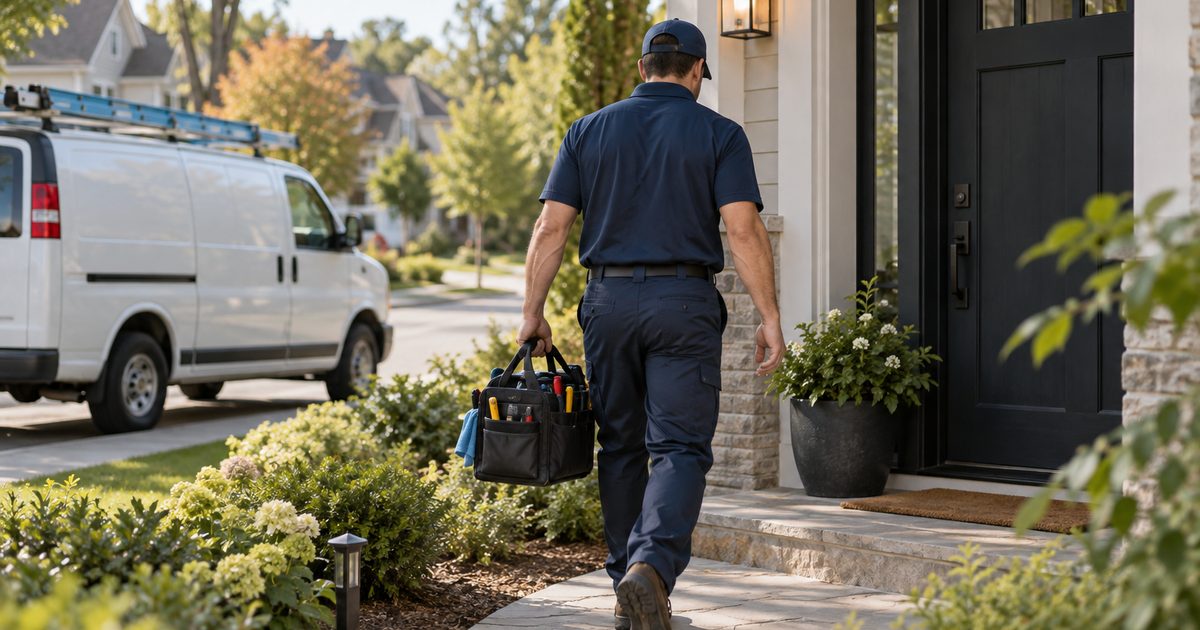
A service area business is a business that serves customers at their homes or properties rather than at its own location. On Google, that means a Business Profile with the address hidden from customers and the areas the business serves shown instead.
A business that goes to its customers has no storefront to point to, so its profile, its reviews and its proof of real work have to establish the trust a physical location would normally provide. At Riley Summers, we set up and present service area businesses so customers can see they’re real, local and established, even though they’ll never visit the office. Hiding the address doesn’t make location irrelevant, though, and that shapes how the business is found.
On this page
- What a Service Area Business Is and Isn’t
- Google’s Rules for Service Area Businesses
- Hiding the Address Doesn’t Remove Distance
- The Doorstep Framework
- Service Area Businesses Compared With Other Local Marketing Topics
- Service Area Business Mistakes We See
- Related Resources
What a Service Area Business Is and Isn’t
A service area business is defined by where the work happens: at the customer’s home or property, not at the business’s own location. This page covers what that business model changes about local marketing, meaning how the business is set up on Google, how it proves it’s real and local without a storefront, and why its location still matters. For the owner, the question is how to look established to customers who will never walk through the door.
It isn’t:
- The profile in general. How any Google Business Profile is kept accurate, complete and active is covered in Google Business Profile.
- Coverage across the area. Making the business visible throughout the territory it serves is covered in Service Area Marketing.
- Website pages for each area. How the website represents individual towns and markets is covered in Location Pages.
- More than one real location. Marketing a business with several genuine, staffed locations is covered in Multi-Location Marketing.
Google’s Rules for Service Area Businesses
Google sets specific rules for businesses that serve customers at their locations. Getting them wrong doesn’t just weaken a profile; it can cost the business the profile entirely.
| Google’s rule | What it means for the business |
|---|---|
| A business without a storefront where it receives customers must hide its address. | Customers see the areas the business serves, not where it’s based. |
| Only one profile for the metropolitan area the business serves. Multiple profiles for the same business in the same metro area can lead to suspension. | Extra profiles to appear in more towns put the whole account at risk. Businesses with genuinely separate locations are covered in Multi-Location Marketing. |
| Service areas are set by cities, postal codes or other areas, with up to 20 listed. | The service area is a list of real places, not a circle drawn around the office. |
| Google recommends keeping the overall area within about two hours’ driving time of where the business is based, though a larger area can suit some businesses. | The area should reflect where the business actually works. |
| A virtual office can’t be listed unless it’s staffed during business hours. | A mailbox or unstaffed office address in another town doesn’t qualify. |
Sources: Google Business Profile Help, Sign up for Business Profile and Guidelines for representing your business on Google.
How we help: Mistakes in how a profile is set up often stay hidden until Google acts on them. Depending on the services a client engages us for, we review the profile against Google’s rules and correct what puts it at risk.
Hiding the Address Doesn’t Remove Distance
Hiding the address changes what customers see, but the business is still based somewhere. Google says local results are based mainly on relevance, distance and prominence (Google Business Profile Help), and nothing in its rules for service area businesses suggests a hidden address takes distance out of that picture.
That’s why the service area listed on a profile and the places the business actually appears can be very different.
Service area: where the business says it works.
Local visibility: where Google actually shows it.
For the owner, a correctly set up profile is the foundation, but it won’t make the business equally visible across every town it lists. Reaching the parts of the area the profile can’t carry is the job of Service Area Marketing.
The Doorstep Framework
A service area business has to show customers it’s real, local and trustworthy without a storefront to do that work for it. At Riley Summers, we use the Doorstep Framework to establish that presence.
- Set It Up Right
- Keep the Area Real
- Prove It’s Local
- Earn Trust at the Doorstep
1. Set It Up Right
The profile starts with the right foundation: set up as a service area business, the address hidden, one profile for the area, and owned by the business itself, with Riley Summers added as a manager. Everything else depends on the profile staying within Google’s rules.
2. Keep the Area Real
The listed service area should be the places the business genuinely serves, within Google’s guidance. An inflated area won’t, on its own, bring in work from farther away, and it can mislead customers about where the business will actually go.
3. Prove It’s Local
Without a storefront, customers look for other signs that the business is part of the community. Photos of real crews, trucks and finished jobs in the area, and a real local phone number used consistently, all help show that. So does content the business publishes about its local involvement, such as community work and sponsorships, on its profile and website. Together they show the business is established and nearby.
4. Earn Trust at the Doorstep
Customers are letting this business into their homes, so trust carries more weight than it does for a storefront they can walk out of. Reviews (see Online Reviews) and visible licenses and credentials (see Credentials & Verification) give customers confidence before the truck arrives.
A correctly established profile is the foundation, but it won’t make the business visible across its whole service area on its own. That’s where Service Area Marketing and its Full Coverage Framework take over.
How we help: A service area business that looks anonymous online can lose jobs to competitors that look established, even when its work is just as good. We help clients present themselves as the real, local business they are, so customers feel confident calling them to their door.
Service Area Businesses Compared With Other Local Marketing Topics
Service area businesses sit at the meeting point of several local marketing topics. Each one answers a different question.
| Service Area Businesses | Google Business Profile | Service Area Marketing | Location Pages | Multi-Location Marketing | |
|---|---|---|---|---|---|
| Main question | How does the business establish a trusted local presence when customers don’t visit it? | Is the business’s own listing accurate, complete and active? | Can customers across the area the business serves find it? | How does the website represent the individual places the business serves? | How are several real locations marketed? |
| When it matters | When the business has no storefront customers visit | From the day the business wants to be found locally | Always, for any business covering more than its immediate neighborhood | When the business serves distinct towns or markets | When the business operates from more than one site |
| Main marketing challenge | Building trust without a public address | Keeping the profile current and within Google’s rules | Visibility that fades with distance from the business | Pages with real local value rather than swapped town names | Keeping each location visible without them competing with each other |
| Key measure | Calls and leads from local search | Calls, website visits and direction requests from the profile | Jobs and job value by ZIP code | Visits and leads from each area’s page | Results for each location |
Does your business look established, legitimate and trustworthy to customers who’ll never visit your office?
Riley Summers will review your profile against Google’s rules for service area businesses, and show you what’s putting it at risk and what’s missing for customers deciding whether to call.
How we know it’s working
For a service area business, the measure is the work that comes from local search: calls and leads, and ultimately booked jobs where the client’s systems allow. Where it fits the business, a dedicated local number on the profile lets us count actual calls rather than taps. The details are covered in Google Business Profile, Call Tracking and Booked-Job Attribution.
Service Area Business Mistakes We See
These are the mistakes that most often put a service area business’s local presence at risk.
-
Showing an address customers can’t visit. A home address or other location where customers aren’t served shouldn’t appear on the profile. Google requires it to be hidden, and showing it also puts the owner’s home address on public display.
What we do instead: set the profile up as a service area business with the address hidden.
-
Virtual or fake offices to appear in other towns. A mailbox or shared office address in another town can look like a way to show up there. Google doesn’t allow it unless the office is staffed during business hours, and it can cost the business its profile.
What we do instead: build presence in other towns through legitimate means (see Service Area Marketing).
-
More than one profile for the same area. Duplicate profiles for the same business in the same metro area can lead to suspension.
What we do instead: keep one profile for the area, and treat genuinely separate locations as a multi-location business.
-
A service area far beyond where the business works. Listing every town within reach won’t, on its own, bring in work from those towns, and it can send customers to a business that won’t come to them.
What we do instead: list the places the business genuinely serves, within Google’s guidance.
-
Assuming a hidden address takes location out of the picture. Hiding the address changes what customers see, not where the business is based, so a hidden address doesn’t create equal visibility across every listed town.
What we do instead: set realistic expectations for local search, and cover the rest of the area through Service Area Marketing.
-
A profile that could belong to anyone. Stock photos, no pictures of real crews or trucks, and nothing about the local community leave customers with nothing to trust.
What we do instead: show the real business: its people, its vehicles, its finished work and its local involvement.
How we help: For a service area business, the profile is the closest thing it has to a front door. We make sure it’s set up within Google’s rules and presents the business as the established, legitimate and trustworthy company it is.
Related Resources

About The Author
Mark Riley is a marketing executive and the founder of Riley Summers Marketing Group, where he leads customer acquisition strategy for home services businesses across paid search, Google Local Services Ads, local SEO and paid social media. He rose to VP of Digital at a national legal-marketing agency, where the digital programs he led generated a significant share of its revenue. Over a 15+ year career, he has managed more than $70 million in digital advertising spend, much of it in one of the most expensive and competitive advertising categories in North America. He measures marketing by what it costs to win a booked job, not by traffic or lead volume.