
Landing Pages for Home Services Businesses
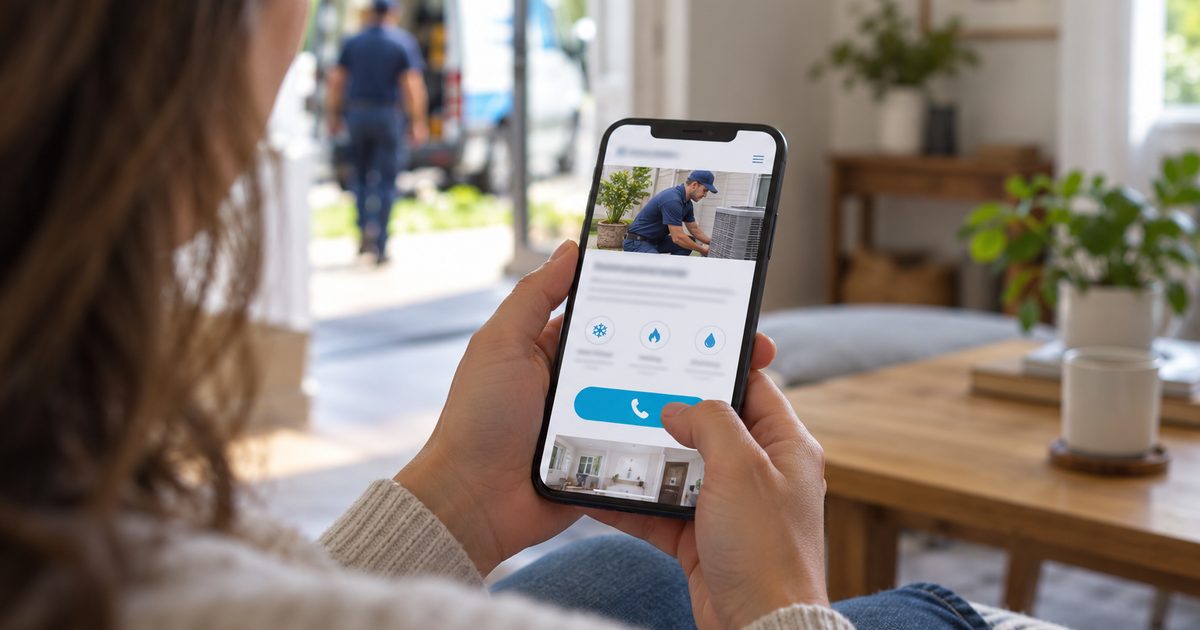
A landing page is a page built for a specific advertising campaign. Its purpose is to control the narrative from the moment a prospective customer clicks: to continue the message they responded to, convince them this business is the best choice to solve their problem, and capture the lead through a call or a contact form. Unlike a service page, which serves every kind of visitor to a website, a landing page exists for one campaign and one outcome.
A landing page carries one message from a prospective customer’s search through to the lead:
Illustrative journey for a prospective customer. The page doesn’t need to repeat the ad word for word, but it has to deliver what the ad promised.
Getting the click is only the first part of paid search. The experience after the click helps decide whether that advertising investment turns into a lead. At Riley Summers, we build service-specific landing pages for the campaigns we manage, so the message a prospective customer clicked on carries through to a clear reason to choose the business and an easy way to make contact.
On this page
- What Landing Pages Are and Aren’t
- Why the Page After the Click Matters
- The Click to Lead Framework
- Results From Landing Pages Mark Riley Designed
- Measuring Landing Pages
- Landing Page Mistakes We See
What Landing Pages Are and Aren’t
A landing page is the experience a prospective customer reaches after clicking a paid ad, built to carry that campaign’s message through to a lead. What makes it a landing page is its purpose, not where it’s hosted or how it’s built.
It isn’t a service page. A service page sits within the business’s website and serves every kind of visitor, while a landing page is built around one campaign (see Service Pages). It also doesn’t decide what the business says about its services in general, which is covered in Service Content.
It isn’t the campaign itself. The keywords, ads and budget that bring prospective customers to the page are covered in Paid Search Advertising. How inquiries from the page are captured and credited to the right campaign is covered in Call Tracking and Form Tracking.
And it isn’t the whole discipline of improving conversion. How the page asks for the call or form is covered in Calls to Action, and the wider process of testing and improving pages is covered in Conversion Rate Optimization.
Why the Page After the Click Matters
In paid search, the business pays for every click, whether or not the prospective customer makes contact. A strong campaign can attract exactly the right people and still waste much of its budget if the page they land on doesn’t convince them. The same ad spend can produce very different results depending on what happens after the click.
Doubling the share of clicks that become leads halves the cost of each lead, without spending a dollar more on ads. More leads don’t automatically mean more booked jobs, though. A page that wins more leads but attracts the wrong ones hasn’t helped. That’s why the goal is a page that convinces the right prospective customers, not just more of them.
Mark Riley has seen this tested directly. Years earlier, his own testing had shown dedicated landing pages outperforming service pages for paid traffic. Later, a manager on his team argued the reverse: that paid traffic would convert better on the website’s existing service pages, and that the extra traffic would help those pages rank in organic search. The campaigns that ran that way underperformed, and Mark believes it contributed to one of the agency’s largest clients reducing its work with them. The search benefit never arrived either. After almost a year of paid traffic, none of those pages ranked higher or saw any noticeable lift in organic traffic, which matches Google’s own position that no one can buy better placement in its search results. Mark’s view is that paid search has no time to wait and no room to experiment on hunches. It needs to work like a faucet the business can turn on for leads and jobs.
How Riley Summers helps: A business can’t control what a click costs, but it can control what happens after it. We build landing pages for the campaigns we manage so more of the clicks a business pays for have a real chance of becoming customers.
The Click to Lead Framework
For the campaigns we manage, we build landing pages around five principles. Together, they keep the page focused on one thing: turning the clicks a business pays for into leads it wants.
1. Match the Search and the Ad
A prospective customer clicks because the ad promised something relevant to what they searched. The landing page has to deliver on that promise straight away. It doesn’t need to repeat the ad word for word, but it has to show the visitor they’ve arrived exactly where the ad said they would.
2. Give the Page One Clear Purpose
A landing page exists for one campaign and one outcome. Everything on it should support that outcome, and anything that pulls the visitor toward unrelated services or pages works against it. Calling and sending a contact form are two ways to reach the same goal, not competing purposes.
3. Answer What Matters Most
The prospective customer needs to know quickly that this business does the work, serves their area, can be trusted, and is easy to reach. The same first-screen standard we use for service pages applies here (see Service Pages).
4. Make Contact Easy
Once the prospective customer decides to reach out, nothing should stand in the way. Calls and contact forms are tracked, so every lead is credited to the campaign that produced it (see Call Tracking and Form Tracking).
5. Measure and Improve
People are people. Once we’ve tracked how prospective customers actually behave on a landing page and optimized for it, that page becomes a strong baseline. New ideas have to beat it on real results, not on the appeal of being new.
How Riley Summers helps: A paid campaign is only as good as the page it sends people to. When we manage a business’s paid search, we design and build its landing pages ourselves and keep improving them, so the business isn’t paying for clicks that go nowhere.
Are your paid clicks landing on a page that wins the lead?
Riley Summers’ free PPC audit reviews your campaigns and the pages your ads send prospective customers to, and shows where clicks you’re paying for may be going to waste.
Results From Landing Pages Mark Riley Designed
In his earlier agency work, Mark Riley designed landing pages for paid search campaigns across many markets, running on exact, phrase and broad match keywords for a range of services. For the client’s highest-volume service, an average of around 33 to 35% of paid clicks became leads, in a category where a single click cost between $60 and $350. Some campaigns did better still, reaching 60 to 75%. The strongest results didn’t come down to one market or one keyword type.
These are results from Mark’s previous work, not a forecast or benchmark. What a landing page achieves depends on the market, the service and the competition. The A/B tests are described in more detail in Website Architecture.
Measuring Landing Pages
A landing page is measured by the leads it produces for the campaign it serves. We look at three levels:
| Level | What it shows | What we look at |
|---|---|---|
| Conversion | Whether the page turns clicks into leads | The share of paid clicks that become calls and contact form leads |
| Cost | What each lead costs the business | Cost per lead, based on ad spend |
| Business results | Whether those leads become paid work | Lead quality from the owner’s feedback, and booked jobs where the client shares that data |
The page and the campaign also need to be read separately. Cost per lead depends on both the share of clicks that convert and what each click costs. A page can convert more of its visitors while cost per lead still rises, because competitors have pushed click prices up. When that happens, the page is doing its job and the pressure is in the auction (see Paid Search Advertising).
Not every call counts as a lead. A call has to last long enough to be a real inquiry before we count it, which keeps the figures honest without filtering out genuine prospective customers (see Phone Leads).
How Riley Summers helps: Clicks and page visits don’t pay the bills. We report the leads each campaign’s landing page produces and what they cost, so the owner can see what their ad spend is actually buying.
Landing Page Mistakes We See
These are the mistakes we most often find when we review the pages a business’s paid campaigns send prospective customers to.
-
Sending paid traffic to a generic home page. The prospective customer clicked an ad for a specific service and lands on a page about everything the business does. They have to search again for what they came for, and many won’t.
What we do instead: We send each campaign to a page built around the service being advertised.
-
A page that doesn’t match the ad. When Mark Riley audits accounts run by other agencies, one of the most common problems is a poorly designed landing page that doesn’t fit the campaign sending traffic to it. The ad promises one thing and the page talks about another.
What we do instead: We build each landing page to deliver what its campaign’s ads promise.
-
Too many places to go. Menus, links to unrelated services and other distractions pull the prospective customer away from the reason they clicked.
What we do instead: We keep the page focused on one campaign and one outcome.
-
Contact harder than it should be. The phone number is hard to find, the form asks for too much, or reaching the business takes more than one step.
What we do instead: We make calling and sending a request as easy as possible, and track both.
-
Generic claims instead of proof. “Fast, friendly, reliable” appears on the page, with nothing to show the business has done this work before.
What we do instead: We use the business’s own proof, such as reviews, real job photos and credentials, to support the case for choosing it.
-
A page that works poorly on a phone. Many prospective customers click from their phones, and a page that’s slow or awkward to use there loses them.
What we do instead: We build landing pages to work as well on a phone as on a desktop (see Mobile User Experience).
-
Counting volume instead of value. A page can produce plenty of leads that never become jobs, and a report that only counts leads hides that.
What we do instead: We count calls only once they’re long enough to be real inquiries, and use the owner’s feedback on which leads were good.
Related Resources

About The Author
Mark Riley is a marketing executive and the founder of Riley Summers Marketing Group, where he leads customer acquisition strategy for law firms and home services businesses across paid search, Google Local Services Ads, local SEO and paid social media. He rose to VP of Digital at a national legal-marketing agency, where the digital programs he led generated a significant share of its revenue. Over a 15+ year career, he has managed more than $70 million in digital advertising spend, much of it in one of the most expensive and competitive advertising categories in North America. He measures marketing by what it costs to win a booked job, not by traffic or lead volume.