
Trust Signals for Home Services Businesses
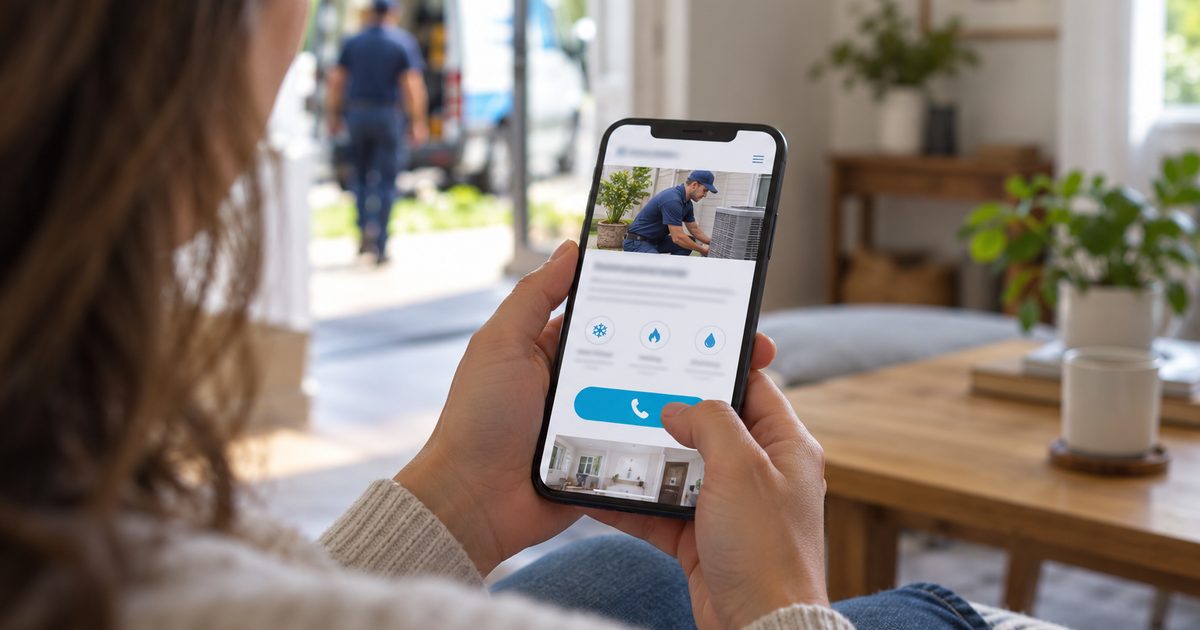
Trust signals are the evidence on a website or landing page that helps customers evaluate whether a home services business is legitimate, qualified, reliable and able to do the work. They include customer reviews, licenses and accreditations, guarantees, real project photos and other proof that backs up what the business says about itself.
Illustrative only. The right proof depends on the service and the customer’s concern, not a fixed set of badges.
Trust signals work best when they answer the customer’s concerns at the moment those concerns arise.
On this page
- What Trust Signals Cover
- Why Trust Signals Matter to Home Services Businesses
- The Proof in Place Framework
- The Trust Signal Checklist
- Trust Signal Mistakes We See
- Trust Signals Across Trades
- What Riley Summers Evaluates
- Related Resources
What Trust Signals Cover
Trust signals cover how a business’s proof appears on its website and landing pages: which evidence is shown, where it sits and whether it answers the concern the customer has at that moment. A claim like “quality service you can trust” isn’t a trust signal. A specific review from a customer who had the same job done is. At Riley Summers, we treat trust signals as part of the page’s job: helping a customer who’s ready to act feel confident enough to call.
Several related topics have their own pages:
- Online Reviews, Credentials & Verification, Customer Testimonials and Project & Service Proof: building the evidence in the first place. This page is about putting that evidence to work on the page.
- Calls to Action: what the page asks the customer to do. Trust signals support that ask.
- Service Pages and Landing Pages: the pages where trust signals do most of their work.
Why Trust Signals Matter to Home Services Businesses
Hiring a home services business means letting a stranger into the house, often for work the homeowner can’t check themselves. Most customers compare several businesses that look much alike (similar ads, similar promises, similar prices) and decide within a few minutes which one to call.
In that moment, proof does what claims can’t. Every business says it’s reliable. A rating with hundreds of reviews behind it, a license number, a guarantee in writing or photos of finished jobs give the customer a reason to believe this business in particular. When that proof is missing, hard to find or doesn’t fit the job, the customer goes back to the list and keeps looking.
For a business paying for its traffic, that matters twice. The marketing has already spent money to bring the customer to the page, and trust signals are often what turns that visit into a call.
How Riley Summers helps: Trust signals are some of the few things on a page that every customer weighs, whatever brought them there. We build them into our campaign landing pages and check that each one answers a real customer concern, rather than filling space.
The Proof in Place Framework
We evaluate trust signals on a page through four questions. Together they move from being seen, to being relevant, to being believed, to being in the right place.
The Proof in Place Framework
1. Show It Early. The customer finds proof before they have to look for it. In Mark Riley’s landing page testing, layout mattered more than any single trust signal, and scroll data showed how far visitors actually got down the page. That determined how much depended on the first screen, so the most important proof belongs there.
2. Make It Specific. The proof matches the service, the concern or the promise being made. A review about a water heater replacement does more on a water heater page than a general “great service” comment.
3. Make It Checkable. Where practical, the customer can confirm what the page claims: a rating that names its source, a license number that can be looked up, a guarantee with clear terms. Not every signal can be checked independently, but the details should be there where they can be.
4. Put It Where They Decide. Proof sits beside the decisions that matter: the offer, the form and the call button. A guarantee next to the form answers “what if it goes wrong?” at the moment the customer is deciding whether to send it.
How Riley Summers helps: We design campaign landing pages around how far customers actually scroll, so the first screen carries what customers ask about first. The headline names exactly what’s being advertised. The cost question comes next, usually answered with a free estimate or inspection, followed by reviews and years in business. The logo is clear, ideally horizontal, and sits near the phone number, so the customer knows at a glance who they’d be calling. Further down, the page supports customers who want more reassurance.
The Trust Signal Checklist
These are the trust signals we see make the most difference on home services pages, in roughly the order customers look for them.
| Trust signal | What it tells the customer | Where it works best |
|---|---|---|
| Free estimate or inspection | Getting in touch costs nothing, which answers the cost question most customers ask first | First screen, right after the headline |
| Review rating, count and source | Many customers have used and rated the business, on a platform they can check | First screen |
| Years in business | The business is established and likely to be around to stand behind the work | First screen or header |
| Clear logo, name and phone number | The business is identifiable and easy to reach | Header, with a horizontal logo beside the phone number |
| Recent, specific reviews | Customers with the same kind of job were satisfied, ideally in the same area | Near the offer and in a review section |
| Satisfaction guarantee or warranty | The business commits to making things right, on clear terms | Beside the form and the offer |
| Before and after photos | The business has done this work, ideally nearby | Service-specific sections |
| Customer testimonials | Customers describe a particular experience and result | Near the matching service claim |
| Licenses | The business holds the credentials the work requires, with a number the customer can look up | Near service claims or in a qualifications section |
| Accreditations and manufacturer certifications | The business meets a recognized standard or is qualified on specific products | Beside the services they apply to |
| Insurance | The business states it carries coverage for the work | Qualifications section |
| Photos of the owners | Real, accountable people stand behind the business | About section or beside the guarantee |
Trust signals should be chosen, not piled up. A page for an emergency repair needs different proof from a page for a roof replacement, and every signal shown has to be accurate and current. We can include team members, but staff change, and every departure means updating photos across the site and landing pages. Owners and partners stay current far longer.
We use a client’s guarantee where it has one. Where a business wants to offer one, we can help shape it for the page.
Trust Signal Mistakes We See
These are the mistakes we most often find when we review a home services business’s website and landing pages.
- Claims instead of proof. “Quality service you can trust” and “#1 in town” are claims every competitor can make. Without something behind them, customers skip past them. What we do instead: we replace general claims with specifics: the rating and review count, the years in business, the guarantee terms.
- Stock photos presented as real work. Customers can often tell a stock photo from a real job, and once they spot one, they start doubting everything else on the page. What we do instead: we use the business’s own before and after photos.
- Badges that can’t be checked or have expired. An outdated accreditation logo, or a “licensed and insured” line with no license number, gives a careful customer a reason to hesitate. What we do instead: we show current credentials with enough detail for the customer to confirm them.
- Proof unrelated to the service. A roof replacement page that shows only reviews about gutter cleaning proves the business has customers, but not that it replaces roofs. What we do instead: we put proof that’s relevant to the service being advertised first.
- Too much competing for attention. Pages crowded with long blocks of text, rows of badges and several sections all fighting for the eye make customers work to find what matters. The proof gets lost, and so does the call to action. Mark Riley spent years as a professional guitarist before marketing, and the lesson carries over: what you leave out matters as much as what you put in. What we do instead: we keep pages focused, with a small number of meaningful signals placed where they support the customer’s decision, and space left around the things that matter most.
- Reviews and testimonials that cross the line. The FTC’s 2024 rule on fake reviews prohibits fake or AI-generated reviews and testimonials, reviews bought in exchange for a positive (or negative) sentiment, and insider reviews that don’t disclose the connection. The FTC’s separate endorsement guidance covers how testimonials are used in advertising more broadly. Google’s policies also prohibit offering incentives for reviews. What we do instead: we use only genuine reviews and testimonials from real customers, and never recommend incentives for reviews.
- Proof buried below the first screen. Even strong proof does little if most visitors never scroll down to it. What we do instead: the proof customers ask about first goes on the first screen.
Trust Signals Across Trades
Different services raise different concerns, so the proof that matters most changes with the job.
| Service situation | The customer’s concern | Most relevant proof |
|---|---|---|
| Emergency plumbing repair | “Can I trust someone to come to my home quickly and fix this?” | 24/7 availability (where it’s real), recent reviews about similar repairs, clear business identity, licenses |
| Roof replacement | “Can this contractor handle an expensive project and stand behind the work?” | Before and after photos of completed roofs, licenses, warranties, manufacturer certifications |
| Recurring pest control | “Will this company deliver consistent service over time?” | Reviews from long-term customers, a satisfaction guarantee, licenses |
| Home security installation | “Is this company qualified to install and support a system that protects my home?” | Relevant certifications, years in business, support commitments |
For emergency work, the first screen leads with 24/7 availability, where the business actually answers around the clock, because the customer’s first question is whether anyone can come now. For planned work, the free estimate or inspection usually leads.
The pattern is the same across trades: evidence works when it answers the concern the job raises, not when it fills a fixed set of slots.
What Riley Summers Evaluates
We evaluate trust signals as part of the marketing, not as decoration. Depending on the services a client engages us for, that covers two areas:
- The campaign landing pages we build and manage. Our landing pages typically include the free estimate or inspection, the review rating, years in business, licenses, accreditations, before and after photos and a satisfaction guarantee where the business offers one. Each is placed in the order customers look for it. The headline names exactly what’s being advertised, and the logo sits beside the phone number.
- Websites we review. In an executive-level website review, we look at whether the business’s proof is visible, specific, current and placed where customers make their decision, and whether the page is clear enough for it to be noticed.
Sometimes much of the proof a business needs already exists, in reviews on its Google Business Profile, licenses, years in business and photos from past jobs, and it just isn’t on the page. But in our experience, layout matters most. Strong proof does little if the page buries it, and a clear layout can make modest proof work hard.
How Riley Summers helps: We start with the layout: what the customer sees first, what they see next and where they decide. Then we put the business’s strongest, most relevant proof in those places.
Is your proof working, or buried?
Riley Summers offers a free website review for home services businesses. We’ll evaluate how your pages present your reviews, credentials and guarantees, and show you where a clearer layout could help more customers decide to call.
Related Resources

About The Author
Mark Riley is a marketing executive and the founder of Riley Summers Marketing Group, where he leads customer acquisition strategy for law firms and home services businesses across paid search, Google Local Services Ads, local SEO and paid social media. He rose to VP of Digital at a national legal-marketing agency, where the digital programs he led generated a significant share of its revenue. Over a 15+ year career, he has managed more than $70 million in digital advertising spend, much of it in one of the most expensive and competitive advertising categories in North America. He measures marketing by what it costs to win a booked job, not by traffic or lead volume.