
Website Performance for Home Services Businesses
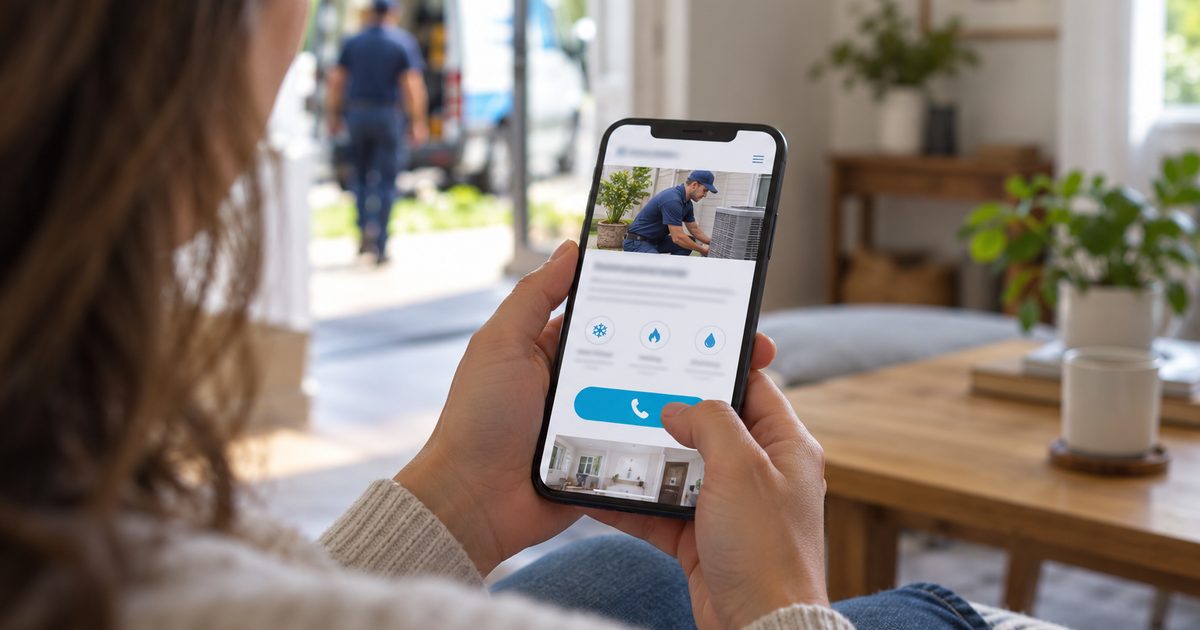
Website performance is how quickly a website loads, how steady and responsive it is while someone uses it, and whether it stays online and working when customers need it. For a home services business, a slow or unreliable page can waste advertising spend and cost the business calls and inquiries from customers its marketing has already reached.
Illustrative only. A slow page doesn’t lose every visitor, but every visitor it loses was already paid for.
Website performance decides whether the opportunity created by marketing survives the customer’s first few seconds on the website.
On this page
- What Website Performance Covers
- Why Website Performance Matters to Home Services Businesses
- The First Seconds Framework
- Where Performance Affects Each Marketing Channel
- How Website Performance Is Measured
- Website Performance Mistakes We See
- What Riley Summers Evaluates
- Website Performance Across Trades
- Related Resources
What Website Performance Covers
Website performance covers whether a page loads quickly, stays steady while it loads, responds when a customer taps it, and keeps working: the site is online, the call button dials and the contact form submits. It is about whether a customer can use the page at all, not what the page says or how it looks. At Riley Summers, we look at performance as a marketing question: does the website hold on to the customer the marketing has already reached?
Several related topics have their own pages:
- Mobile User Experience: whether a page is comfortable to use on a phone. A page can load instantly and still be awkward to read or tap.
- Service Pages: what a page says about the service and whether it answers the customer’s questions.
- Website Accessibility: whether people with different abilities can use the site.
- Conversion Rate Optimization: testing changes that turn more visitors into leads. Performance is often one of the first things checked, but conversion work covers far more.
- Lead Tracking: whether calls and contact forms are recorded correctly in reporting. A tracking failure is a reporting problem, because the customer may still have reached the business.
Why Website Performance Matters to Home Services Businesses
Most home services customers find a business on their phone, often while they’re dealing with the problem: water on the utility room floor, a house that keeps getting warmer, a ceiling stain that appeared overnight. They aren’t browsing. They want to know quickly whether this business can help and how to reach it, and the next option is one tap of the Back button away.
That makes the first few seconds on the website part of the marketing. With paid search, paid social and remarketing, the business has already paid to bring the customer to the page, whether or not the page finishes loading. In organic search and the local results, the customer has picked this business out of several, and a page that stalls sends them back to the list to choose again.
Performance doesn’t win the job on its own. A fast page still needs the right message, a clear offer and someone at the business who answers the phone and books the work. A slow or broken page can undo all of that before any of it has a chance to work.
How Riley Summers helps: Performance problems rarely appear in a campaign report as performance problems. They look like weak ads, a poor channel or a slow month. We evaluate the website as part of the campaign, so a problem on the page isn’t mistaken for a problem with the marketing.
The First Seconds Framework
We evaluate a website’s performance through four questions about the customer’s first seconds on the page. The first three line up broadly with the measures Google uses for page experience, known as Core Web Vitals. The fourth asks whether the website does its job at all.
The First Seconds Framework
1. Load Quickly. The customer sees what matters (what the business does, where it works, how to reach it) without waiting for it. On a phone, over a cell signal, the main content should appear before the customer has a reason to leave.
2. Stay Steady. Text, images and buttons stay where they are while the page finishes loading. When a layout jumps, customers lose their place or tap the wrong thing. A call button that moves as the customer’s thumb comes down is a call that doesn’t happen.
3. Respond Immediately. When a customer taps a menu, a button or a form field, something happens right away. A page that looks loaded but doesn’t respond feels broken.
4. Work Reliably. The site is online, the call button dials the right number, and the contact form submits and reaches the business. That has to hold after every update, not just on launch day.
How Riley Summers helps: A page that falls short on any of these four loses customers the business has already paid or worked to reach. We evaluate pages against all four and flag what needs fixing, whether it’s work we can take on or work for the business’s web developer.
Where Performance Affects Each Marketing Channel
Website performance doesn’t matter equally to every lead path. It matters most where the marketing sends the customer to the website, and least where the customer can contact the business without visiting it.
| Channel | How the customer reaches the business | How much performance matters |
|---|---|---|
| Paid Search | Ad click to a landing page or website | Direct. The click is paid for whether or not the page loads, and landing page experience is part of how Google rates the ad. |
| Paid Social | Ad click to a page, for campaigns that send traffic to a website | Direct for website-bound campaigns. Customers arrive mid-scroll, with little reason to wait for a slow page. |
| Remarketing | A return visit from an ad | Direct. The customer is coming back to decide, and a slow return visit can lose them a second time. |
| Organic Search | A search result click to the website | Direct after the click. Google’s ranking systems also use Core Web Vitals, though good scores don’t guarantee rankings. |
| Google Business Profile & Local Results | A call from the profile, or a tap through to the website | Partial. Many customers call straight from the profile. Performance matters for those who tap through to the website. |
| Local Services Ads | A call or message through the ad | Least direct. Customers contact the business through Google’s ad, often without visiting the website. |
How Riley Summers helps: Performance matters more on some lead paths than others, so we weigh it by where a business’s leads actually come from. A business whose leads mostly arrive through Local Services Ads and profile calls has different priorities from one that relies on paid search.
How Website Performance Is Measured
No single number proves a website has a performance problem. We look at three kinds of evidence together: how the page performs for real visitors, what the business results show, and whether the site’s contact paths are working.
How the page performs for real visitors
Google measures page experience with three Core Web Vitals, based on real visits to the site:
| Measure | What it covers | Google’s “good” threshold |
|---|---|---|
| Largest Contentful Paint (LCP) | Loading: how long the main content takes to appear | 2.5 seconds or less |
| Interaction to Next Paint (INP) | Responsiveness: how quickly the page reacts to a tap or click | 200 milliseconds or less |
| Cumulative Layout Shift (CLS) | Stability: how much the layout moves while it loads | 0.1 or less |
Google assesses each one at the 75th percentile of page loads, separately for mobile and desktop. Most visits, not just the best ones, need to meet the threshold.
Depending on the services a client engages us for, we review page performance monthly in Google’s PageSpeed Insights. That covers the campaign landing pages we build and manage, and the website’s home page where we work on the client’s site. PageSpeed Insights shows how a page performs for real visitors (Core Web Vitals, where Google has enough visit data) alongside a controlled test of the page.
What the business results show
- A gap between paid clicks and landing page visits. A large gap is a warning sign that customers are leaving before the page loads. Consent settings, ad blockers and the way analytics is set up can also create a gap, so it’s a prompt to look closer, not proof.
- A sudden drop in one contact method. When contact form leads stop on a site that normally gets them while calls carry on, the form is the first thing to check.
- A below-average landing page experience rating in Google Ads. Google rates how relevant and useful the landing page is to people who click the ad, so the rating can point to speed but also to relevance or ease of use.
Whether the contact paths work
A page can score well on speed and still fail to deliver a lead. A form that submits and a call button that dials matter as much as how fast the page loads.
Website Performance Mistakes We See
These are the mistakes we most often find when we review a home services business’s website and campaign pages.
- A speed tool that broke the page it was meant to speed up. Speed and caching tools change how a page is delivered, and an update can break something without warning. We’ve seen an update to one of these tools stop a contact form from working. A site that normally received a steady flow of form leads went several days without one, and only a review of the drop found the cause. What we do instead: we treat a sudden drop in one contact method as a reliability warning, and check the form before assuming the marketing has changed.
- A fast home page and slow campaign landing pages. In other agencies’ campaigns, we often find the home page performing well while the pages the ad spend actually lands on load slowly. What we do instead: we evaluate the pages customers arrive on, not just the home page.
- Checking the site on an office computer. A site that feels quick on a desktop over office internet can be slow on a phone over a cell signal, which is how most customers see it. What we do instead: we look at mobile performance first.
- Add-ons piling up. Chat widgets, pop-ups, sliders, review feeds and tracking tags each add load time, and few sites ever remove one. What we do instead: we weigh what each addition contributes against what it costs in load time, including the tracking our own campaigns rely on.
- Several parties changing the site without telling each other. When an agency, a web developer and the business’s own staff all have access, one change can break something another party depends on, and no one knows who changed what. What we do instead: where we’re responsible for a site, we keep an activity log of who changed what and when, so a problem can be traced to its cause. When many people have admin access, whether or not we’re responsible for the site, we let the business know. Every extra set of hands makes the site harder to keep working and harder to hold anyone accountable when something breaks.
- Treating a speed score as the goal. A perfect score doesn’t help if the form doesn’t submit. What we do instead: we evaluate performance by whether customers can reach the business, with the score as one input.
What Riley Summers Evaluates
We evaluate website performance as part of the marketing, not as a separate technical project. Depending on the services a client engages us for, that covers three areas:
- The campaign landing pages we build and manage. For the campaigns we run, we build and manage the landing pages ourselves, so their speed and reliability are ours to control and monitor. The pages the ad spend lands on are held to the First Seconds standard.
- The business’s own website. This is where customers from organic search, the local results and the Google Business Profile arrive. Where we work on a client’s site, we review its performance alongside the content we write and publish.
- Websites we review. In an executive-level website review, performance is one of the things we evaluate, alongside how the site is organized, what its service pages say and how easily a customer can get in touch.
What happens next depends on who is responsible for the site. Where it fits the engagement, we can take on the performance work ourselves. Where the business has its own web developer, we explain what we found and why it matters to the marketing, so the developer can fix it and the owner understands what it may be costing.
How Riley Summers helps: Owners rarely hear about website performance in terms of calls and booked jobs. Mark Riley has spent more than 15 years architecting, building and launching service business websites, and our reviews put performance problems in the terms that matter to the business: the customers it may be losing and the spend that may be going to waste.
Is your website losing customers your marketing already reached?
Riley Summers offers a free website review for home services businesses. We’ll evaluate how your site performs for the customers your marketing sends to it, and show you where speed or reliability problems may be costing you calls and inquiries.
Website Performance Across Trades
Every home services business needs a website that loads, holds steady and works. What changes from trade to trade is which part of the visit carries the most weight.
| Type of need | Examples across trades | What performance has to protect |
|---|---|---|
| Emergency and urgent repair | A burst pipe for a plumbing company, no cooling in summer for an HVAC company, a storm-damaged roof for a roofing company | The phone number and call button, visible and working the moment the page opens |
| Routine and recurring service | A quarterly treatment for a pest control company, weekly service for a pool company, regular visits for a lawn care or cleaning company | Pages that load across the few visits a customer may make while comparing options, and contact forms that submit |
| Planned replacement and projects | A system replacement for an HVAC company, a full re-roof for a roofing company, a monitoring system for a home security company | Every page the customer reads while researching, including return visits from remarketing |
Two patterns: When the need is urgent, the website’s job is to put the customer in touch with the business, so load speed and a working call button carry most of the weight. When the need is planned, the customer tends to read more and come back, so performance across the whole site and on return visits matters more. In both cases, a page that doesn’t work loses a customer the marketing has already reached.
Related Resources

About The Author
Mark Riley is a marketing executive and the founder of Riley Summers Marketing Group, where he leads customer acquisition strategy for law firms and home services businesses across paid search, Google Local Services Ads, local SEO and paid social media. He rose to VP of Digital at a national legal-marketing agency, where the digital programs he led generated a significant share of its revenue. Over a 15+ year career, he has managed more than $70 million in digital advertising spend, much of it in one of the most expensive and competitive advertising categories in North America. He measures marketing by what it costs to win a booked job, not by traffic or lead volume.